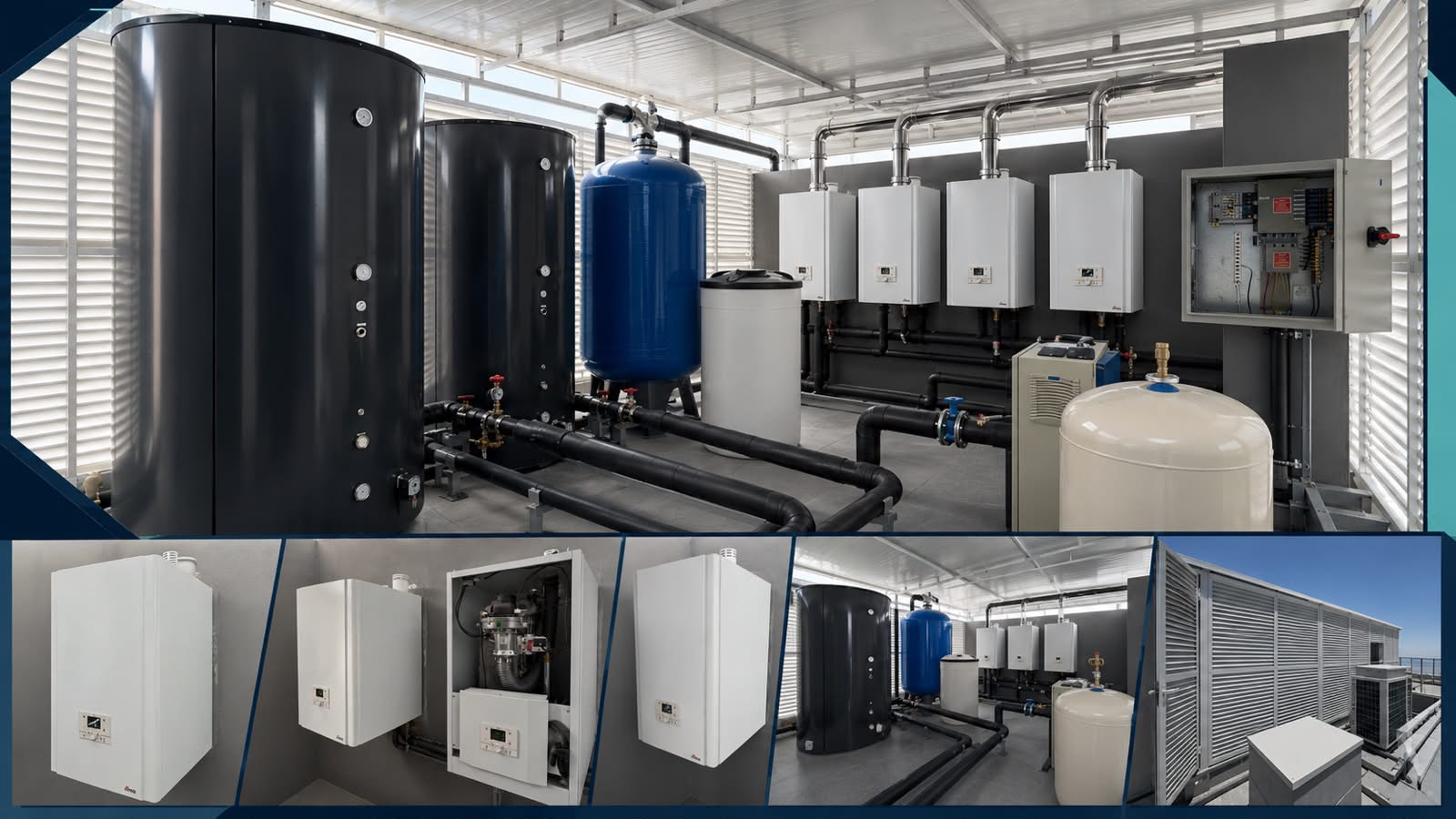
When you ask what a ” boiler ” is to different people, you’ll probably get slightly different answers. Some picture the diesel-fired units tucked away in a hotel plant room. Others think of the compact wall-hung unit heating water for a small office. A few will say “it’s the thing that makes hot water,” which, honestly, isn’t far off. If you searched for this topic, you likely landed here because you’re either specifying equipment for a new build, troubleshooting an old system, or trying to figure out who actually supplies and services these things across the UAE. This guide covers the basics: what a boiler is, what it’s used for, the main types, where it fits into a building’s HVAC setup, and how to think about sourcing and upgrading one in Dubai.
What Is a Boiler?
A boiler is a closed vessel that heats water, or converts water into steam, using a fuel source such as LPG, natural gas, diesel, or electricity. The heat generated is then distributed through a building to provide hot water, space heating, or steam for industrial processes. The word itself is old, dating back to when steam power first ran factories and ships, but the underlying principle hasn’t changed: apply controlled heat to water, capture that thermal energy, and put it to work.
In a commercial context, “boiler” usually refers to a purpose-built heating appliance serving a hotel, hospital, residential tower, or industrial facility rather than a small domestic unit. That distinction is important in UAE, where most boilers installed are commercial-grade, engineered for continuous operation and higher hot water demand than you’d see in a typical household.
What Is a Boiler Used For?
Boilers exist to solve one problem: reliable, on-demand heat. In practice, that shows up in a few recurring ways across UAE buildings.
- Domestic and guest hot water – hotels and residential towers rely on boilers to supply hot water to hundreds of rooms simultaneously, often paired with hot water storage tanks or calorifiers to smooth out peak demand.
- Space heating – even in a hot climate, hospitals, gyms, and certain industrial spaces need consistent heating for comfort or process control, particularly during winter months and in air-conditioned interiors.
- Process heating in industry – food processing, laundries, textiles, and pharmaceutical facilities use boiler-generated steam or hot water as a direct input to their production process.
- Backup and supplementary heating – in some projects, boilers work alongside solar water heating or heat pump systems, stepping in during periods of high demand or low solar yield.
If you’re confused whether your building needs one, the real question isn’t “do we need hot water,” it’s “how much, how consistently, and at what pressure.”
What Are the Three Types of Boilers?
The answer depends slightly on whether you’re asking from a residential or commercial angle. For commercial and industrial buyers, the three core categories are usually defined by construction and heat transfer method.
Fire-tube boilers pass hot combustion gases through tubes that are surrounded by water. They’re a well-established, relatively straightforward design, commonly used for general commercial heating and hot water applications where pressure requirements aren’t extreme.
Water-tube boilers flip that arrangement, circulating water through tubes that are exposed to hot gases on the outside. This construction handles higher pressures and larger loads more efficiently, which is why it turns up in bigger industrial and process-heating setups.
Electric boilers skip combustion entirely, using electric heating elements to generate heat. They’re a useful option where gas or LPG supply is impractical, and they align with facilities looking to reduce on-site emissions.
Beyond this construction-based split, boilers are also commonly grouped by fuel type (LPG, natural gas, diesel, electric) and by format, such as condensing, wall-hung, or floor-standing units, each suited to different space and capacity requirements.
Here’s a comparison of the three core types:
| Type | How it works | Best suited for | Pressure/capacity |
|---|---|---|---|
| Fire-tube boiler | Hot combustion gases pass through tubes surrounded by water | General commercial heating and hot water: hotels, hospitals, offices | Lower to moderate pressure requirements |
| Water-tube boiler | Water circulates through tubes exposed to hot gases on the outside | Larger industrial and process-heating applications | Higher pressures and larger loads |
| Electric boiler | Electric heating elements generate heat directly, no combustion | Sites without gas/LPG supply, or facilities reducing on-site emissions | Varies by unit; no fuel storage needed |
Need help specifying the right type for your project? Cauldron’s boiler range covers all three.
What Is a Boiler in HVAC?
Within an HVAC (Heating, Ventilation, and Air Conditioning) system, a boiler is the component responsible for the “H.” It generates the hot water or steam that a hydronic heating system then distributes through pipework to radiators, fan coil units, underfloor heating, or air handling units. In a commercial HVAC design, the boiler works as one part of a larger loop: it produces heat, a distribution network moves it where it’s needed, and controls manage temperature and flow to match demand.
In UAE, “HVAC” conversations lean heavily toward the cooling side given the climate, but boilers still play a defined role, particularly for guest-facing hot water in hospitality, medical sterilization and washing requirements in healthcare, and process heat in industrial facilities.
Why Does Boiler Demand in the UAE Look a Little Different?
A few regional factors shape how boilers get specified and bought here. Piped natural gas isn’t as widely available as in many other markets, which pushes a large share of commercial boilers toward LPG as the practical fuel choice. Hospitality demand is a major driver too. Dubai and Abu Dhabi’s hotel sector needs boiler capacity that can handle simultaneous hot water draw across hundreds of rooms without a dip in temperature or pressure. And because a meaningful share of the building stock is now over a decade old, there’s a steady, ongoing market for boiler upgradation rather than only new installations.
How to Choose Reliable Boiler Manufacturers and Suppliers in UAE?
Not every supplier sourcing boilers into the UAE is set up to support them properly once they’re installed. A few things worth checking before committing to a manufacturer or supplier:
- Fuel compatibility and local approvals – confirm the unit is designed for LPG or your intended fuel source and meets local civil defence and safety requirements.
- After-sales support and spare parts – a boiler is only as reliable as the servicing behind it. Ask how quickly spare parts and technical callouts are available.
- Track record with your building type – a supplier experienced with hotel and hospital-scale hot water demand will spec differently than one used to small commercial units.
- Integration capability – if your project needs the boiler to work alongside hot water storage tanks, calorifiers, or water treatment equipment, look for a supplier who can advise on the full system, not just the unit itself.
Cauldron supplies a full range of condensing, wall-hung and floor-standing commercial boilers engineered for hotels, hospitals, residential towers and industrial facilities across the UAE, alongside the after-sales support needed to keep them running.
When to Consider Boiler Upgradation Services in Dubai?
Boilers rarely fail overnight; they tend to send warning signs first. Rising fuel bills without a change in usage, inconsistent hot water temperature, more frequent breakdowns, and unusual noise from an ageing unit are all reasonably common indicators that a system is due for an upgrade rather than another repair. Retrofitting to a condensing boiler, in particular, can meaningfully cut fuel consumption compared to an older, non-condensing unit still in service.
If any of that sounds familiar, it’s worth getting the system assessed before the next breakdown forces the decision. Cauldron’s team provides engineering, installation and boiler upgradation services across Dubai and the wider UAE, covering everything from system design and equipment selection through to retrofit, commissioning and ongoing maintenance support.
Conclusion
A boiler is a simple concept doing a genuinely important job: turning fuel into usable heat, reliably, for years at a stretch. Once you understand the type that fits your application and what a credible manufacturer or supplier should offer around it, the rest of the decision gets a lot easier.
If you’re further along and already thinking about capacity or sizing, our guide on how to size a commercial boiler explains the load calculations in detail, and our breakdown of how commercial boiler systems work goes deeper into the mechanics behind the categories covered here.
For UAE projects that need boilers specified, supplied, or upgraded, Cauldron’s team can help you work through the details.
Frequently Asked Questions:
Who are the top boiler suppliers in UAE?
UAE’s boiler market includes both international manufacturers supplying through local distributors and regional suppliers offering end-to-end service. Cauldron supplies commercial-grade condensing, wall-hung and floor-standing boilers, including Viessmann boilers, across Dubai, Abu Dhabi and the wider UAE, with installation, retrofit and after-sales support included.
Are there boiler manufacturers based in UAE, or is equipment imported?
Most commercial boiler units used in UAE are manufactured internationally and brought in through established local suppliers, since building-grade boilers require certified manufacturing standards and after-sales infrastructure that’s more practical to source through a specialised distributor than a local factory. What matters more than country of manufacture is whether your supplier can provide local installation, spare parts and servicing.
What should I check before choosing a boiler supplier in Dubai?
Confirm fuel compatibility (LPG, natural gas, diesel or electric) and local civil defence approval, ask about spare parts and callout response times, check the supplier’s track record with your building type (hotel-scale hot water demand is a different spec than a small commercial unit), and confirm they can advise on the full system, like hot water storage, calorifiers, water treatment.
Is “boiler supplier” different from “boiler manufacturer”?
Yes. A manufacturer builds the equipment; a supplier sources, specifies, installs and services it for your project. In UAE, most commercial buyers work with a supplier rather than importing directly from a manufacturer, since the supplier handles local compliance, sizing, installation and ongoing maintenance.