If you run a hotel, a factory, or a processing plant in Dubai, you’ve probably had this conversation with your maintenance team at least once: why does the boiler keep scaling up, why do the chillers need cleaning more often than they should, and why does the drinking water taste different depending on the week. Nine times out of ten, the answer traces back to one thing – the quality of the feed water going into your systems.
Dubai’s water supply, whether it comes from the municipal desalinated network, a borehole, or a tanker, rarely stays consistent. TDS levels shift, hardness varies, and summer heat pushes everything to its limit. This is exactly the gap an industrial RO plant is built to close, and it’s why more UAE businesses are treating reverse osmosis as essential infrastructure rather than an optional upgrade.
What Is an Industrial RO Plant?
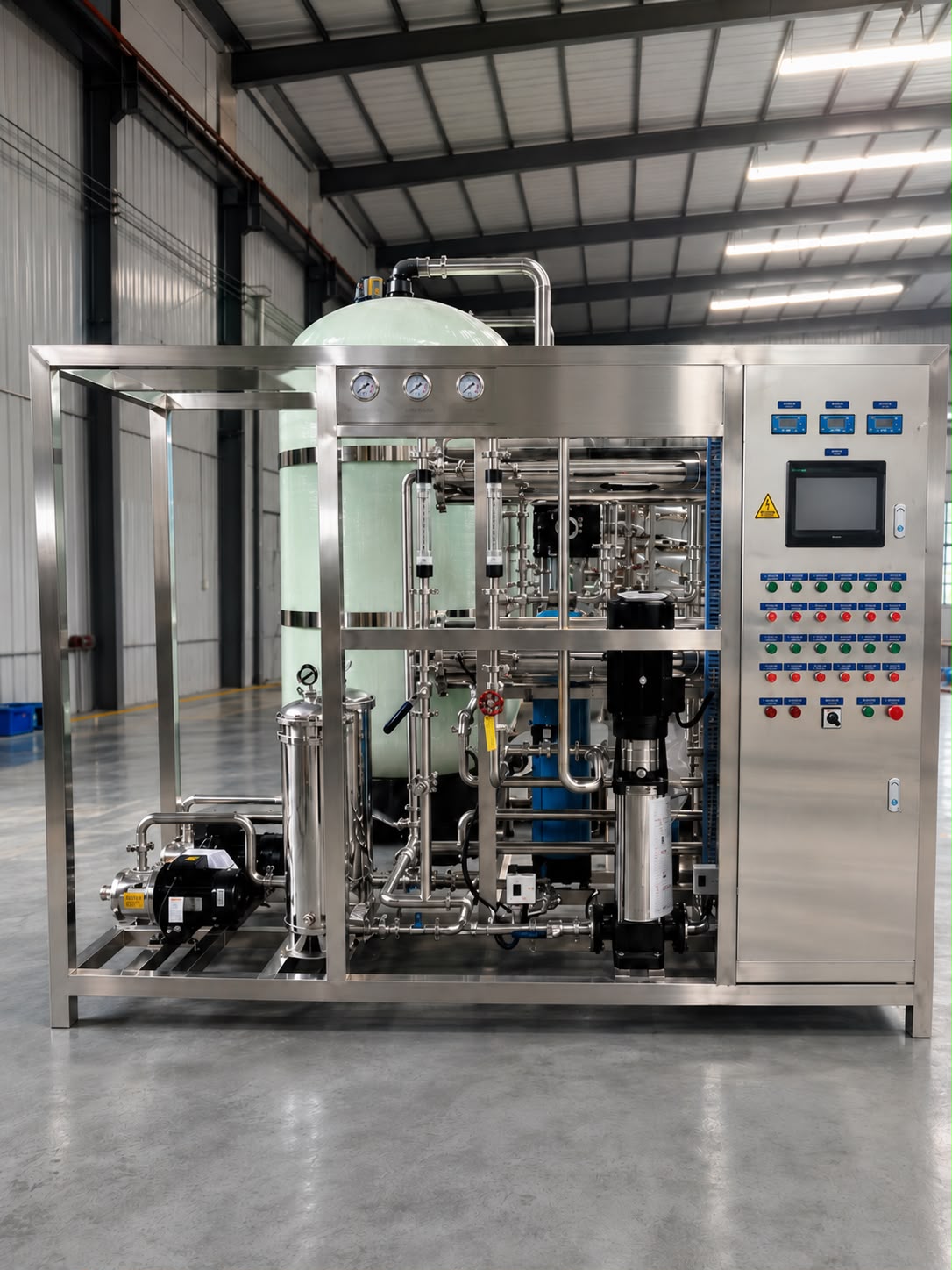
Reverse osmosis works by forcing pretreated water through a semi-permeable membrane under pressure. The membrane blocks dissolved salts, minerals, and most contaminants, letting only clean, low-TDS water (the permeate) through, while the concentrated reject water is carried away to drain. A typical treatment line runs from a raw water tank through multimedia filtration, carbon filtration, softening or antiscalant dosing, a fine cartridge filter, and finally the high-pressure RO membrane stage itself, with optional UV or remineralisation afterward.
When done properly, this single-stage process rejects 96 to 99% of dissolved salts and contaminants. When done poorly, undersized, badly pretreated, or bought off a generic catalogue, then it becomes a maintenance headache instead of a solution. This is especially important in the UAE, where feed water conditions are rarely straightforward. Every water source has its own challenges, so the system needs to be selected and designed accordingly.
Why Dubai’s Water Conditions Make RO Non-Negotiable
Three local realities make RO necessary:
High and variable TDS. Between desalinated supply, groundwater, and tankered water, total dissolved solids can swing significantly from one source or season to the next. Equipment designed around a single assumed water quality often struggles the moment that assumption stops holding.
Summer heat cuts membrane output. RO membranes produce less permeate as the feed water gets warmer. A system sized only against nominal, cooler-weather flow can fall short exactly when demand, such as hotel occupancy or a factory running full shifts, peaks in July and August.
Everything downstream depends on it. Boilers, calorifiers, and chillers are all sensitive to what’s feeding them. Hard, high-TDS water scales heat exchange surfaces and steadily eats into efficiency and equipment life, long before anyone notices a drop in output.
The Benefits of an Industrial RO Plant
1. Water quality you can actually rely on
With online conductivity monitoring and auto-divert built in, an industrial RO system keeps out-of-spec water from ever reaching your process or your taps, regardless of how much feed conditions drift through the day.
2. It protects the equipment you’ve already paid for
This is the benefit most businesses discover the hard way. Low-TDS RO water dramatically cuts scale formation in boilers, calorifiers, steam equipment, and heat exchangers. Less scale means better heat transfer, lower energy bills, and equipment that lasts as long as it’s supposed to instead of needing early replacement.
3. Lower cost over the life of the plant
A well-designed pretreatment stage, media filtration, carbon, softening, or antiscalant dosing reduces fouling and scaling at the membrane itself. That translates directly into fewer membrane replacements and lower chemical dosing costs over years of operation, not just a lower price tag on day one.
4. High rejection of salts and contaminants
Because membrane rejection typically sits at 96–99%, a single RO stage removes the overwhelming majority of dissolved salts, minerals, and contaminants in one pass; no need to stack multiple treatment technologies to hit a usable water quality.
5. Built around UAE operating conditions, not generic specs
A properly engineered plant is sized against summer feed-water temperatures, not just a nominal flow rate on a spec sheet. That’s the difference between a system that performs year-round and one that quietly underdelivers for four months of the year.
6. Automation that matches how you actually operate
Options range from simple manual or metered control up to full PLC systems with remote monitoring and telemetry. That flexibility means a plant can run with a lean on-site team or largely unattended, depending on what suits your operation.
7. Real water and cost savings through recovery
On brackish-water systems, recovery rates of 50–75% are achievable, cutting both reject volume and overall feed-water consumption; a meaningful saving when every cubic metre of feed water has a cost attached to it.
8. Serviceable by design, not as an afterthought
CIP connections, isolation valves, and sampling points built in from the start mean membrane cleaning and routine servicing don’t require shutting down the wider plant to get at them.
9. A format that fits your site
Skid-mounted, plant-room, or containerised, the right industrial RO system is chosen around your site constraints, not the other way around. A retrofit into an existing building calls for a different format than a fast-track construction site.
10. Supports compliance and sustainability targets
Consistent treated-water quality paired with reduced fresh-water draw helps meet authority specifications and green-building or water-efficiency targets – Estidama being a common example on UAE projects.
Who Needs an RO System?
In practice, the businesses that benefit most from an industrial RO plant in Dubai include hotels and resorts needing potable water polishing and softened water for kitchens, hospitals requiring multi-barrier treatment for CSSD and laboratory use, factories and food processing plants needing consistent process water, laundries relying on softened or RO-fed water for chemical efficiency, and construction sites where a containerised plant delivers temporary potable and batching water without waiting on permanent infrastructure.
If your operation depends on a boiler, a calorifier, or a chiller running efficiently day after day, feed water quality is the thing that determines how long that equipment actually lasts.
Sizing It Right
Before choosing capacity, the key questions are: what’s your daily and peak demand, what does your feed water actually look like (a proper water analysis, not a guess), and what product-water quality do you need at the other end. As a rough guide, small commercial setups typically sit in the 250–1,000 L/hr range, mid-size hotels and buildings need 1–5 m³/hr, and industrial or process applications usually call for 5–20 m³/hr or more. But these are starting points, not substitutes for an actual site assessment.
Conclusion
An industrial RO plant is only as good as the engineering behind it. Undersize it, skip proper pretreatment, or ignore UAE summer conditions in the design, and you’ll end up with a system that fights you instead of working for you. Get it right, and it quietly protects your boilers, calorifiers and chillers for years while cutting your operating costs.
Cauldron designs, supplies, installs, and commissions industrial RO systems across the UAE, engineered around each client’s actual water analysis rather than pulled from a fixed catalogue. Explore the full range of industrial RO systems and reverse osmosis plants we build for hotels, factories, hospitals, and construction sites across Dubai and the wider UAE, including skid, plant-room, and containerised formats.
Since RO systems are so often installed to protect other equipment, it’s worth looking at how they work alongside the rest of your plant room. Our calorifiers and boilers depend on correctly treated make-up water to avoid scaling, and our water chillers benefit from the same clean feed on their condenser circuits. If you’re still deciding between filtration options, our water filtration range covers the pretreatment stages that keep an RO membrane performing for years instead of months.
Not sure what capacity or format your site needs? Get in touch with your water analysis and daily demand, and Cauldron will come back with a preliminary system recommendation within five working days.