
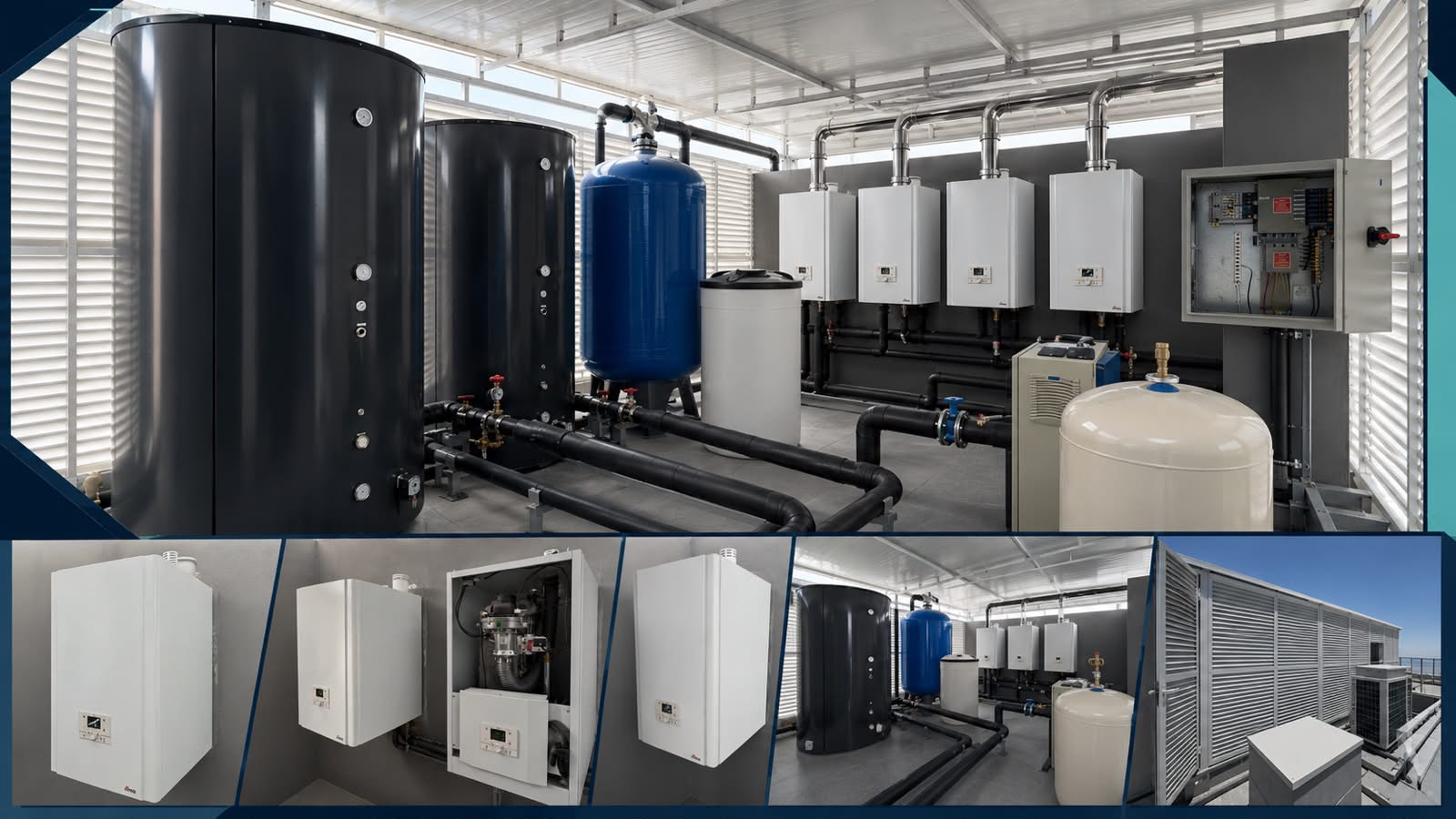
A facilities manager in Dubai once told his hotel had gone through three boiler replacements in under a decade, not because the equipment kept failing, but because nobody had sized it properly the first time. One unit was too small and struggled through winter mornings. The next was oversized and short-cycled itself into an early grave. The third, finally, got it right.
That story isn’t unusual. Sizing gets treated as an afterthought, something the installer figures out on-site, when it’s actually the single decision that determines how much you’ll spend on fuel, repairs, and replacements for the next fifteen years.
If you already know how a commercial boiler works mechanically, you can skip ahead; we’ve covered that in detail in our guide on how commercial boiler systems work. This guide is about the number that is important when you’re specifying equipment: how big does it need to be?
Why is sizing important?
Oversizing feels like the “safe” choice, and salespeople rarely discourage it. But an oversized boiler cycles on and off constantly because it produces more heat than the building needs at any given moment. That short-cycling wears out burners, wastes fuel, and shows up as an unexplained jump in the utility bill.
Undersizing is the opposite problem: guests complain about lukewarm showers, kitchens can’t keep up during peak service, and the system runs flat out around the clock trying to catch up. Neither mistake is cheap to fix once the plant room is built around it.
kW and TPH
Two units come up constantly when you’re comparing boiler quotes, and they confuse almost everyone outside the industry.
Kilowatts (kW) measure the rate of heat output – how much energy the boiler can deliver at any moment. A small hotel wing might run comfortably on a 150–300 kW hot water boiler, while a large hospital or manufacturing plant can require several megawatts split across multiple units for redundancy.
Tonnes per hour (TPH) is the unit used for steam boilers, and it measures how much steam the boiler can generate in an hour. A 1 TPH boiler produces roughly 1,000 kg of steam per hour, which converts to approximately 700 kW of thermal output; the exact figure shifts depending on operating pressure and feedwater temperature. Industrial laundries, food processing lines, and sterilization units in the UAE typically spec their equipment in TPH rather than kW, simply because that’s the unit their process engineers already work in.
If a supplier quotes you one unit and your consultant’s report uses the other, ask for a conversion rather than guessing.
Working Out the Actual Heating Load
A proper load calculation looks at three things, added together:
- Domestic hot water demand — occupancy, number of outlets, and simultaneous usage patterns (a 200-room hotel behaves very differently at 7am than at 2pm)
- Space heating load — building envelope, glazing, insulation, and design temperature difference
- Process heating — laundries, kitchens, sterilization, or manufacturing processes that need dedicated capacity
Skipping any one of these is how undersizing happens. A common shortcut of sizing purely off floor area ignores that a hospital and an office tower of the same square footage have wildly different hot water demands.
For anything beyond a small standalone unit, this calculation is worth having an engineer run properly rather than relying on a rule of thumb. It’s a service we handle directly as part of our engineering and installation support for commercial projects across Dubai, Abu Dhabi, and Sharjah.
Steam or Hot Water: Which Applies to Your Building?
Hotels, residential towers, offices and schools almost always run on hot water boilers, since the end use is showers, taps, space heating and calorifiers feeding hot water storage tanks. Steam boilers show up where the process genuinely needs steam, sterilization in hospitals, humidification, commercial kitchens, or industrial processing lines. If your building falls into the second category, your capacity conversation will be in TPH; almost everyone else should be thinking in kW.
Water Quality and TDS
Here’s something that rarely comes up until it’s already a problem. Boiler performance depends heavily on feedwater quality, and the key number to watch is TDS: Total Dissolved Solids. A healthy hot water boiler generally sits in the range of 2,000–3,000 ppm TDS, while steam boilers need to be kept tighter, often below 3,500 ppm depending on operating pressure, because dissolved solids concentrate as water boils off and can scale the heat exchanger or foam over into the steam line, according to
UAE feedwater, often a mix of desalinated and groundwater sources, varies enough between emirates that it’s worth testing before commissioning, not after the first descale. Proper water treatment for boiler feedwater keeps TDS in range and protects the investment you just spent time sizing correctly.
A Note on Boiler Passes
You’ll sometimes see boilers described by their number of “passes” – 2-pass, 3-pass, or 4-pass. This refers to how many times combustion gases travel through the boiler before exiting the flue. Each additional pass extracts more heat from the same fuel burn, which is why 4-pass boilers tend to run more efficiently than 2-pass designs, at the cost of a slightly larger footprint. It’s a detail worth asking about when comparing quotes, though it matters less than getting the overall kW or TPH figure right in the first place.
Getting It Right the First Time
Finding the right commercial boiler size requires careful planning. Between load calculations, unit conversions, fuel choice, and water quality, there are enough variables that a proper assessment pays for itself long before the first service call. If your building already has a boiler and you’re noticing rising fuel bills or inconsistent hot water, it’s worth reading up on routine boiler maintenance, as well as sizing and upkeep tend to go hand in hand.
We work with clients across the UAE as part of our standard project scope, whether that’s a new commercial boiler installation or replacing an ageing system that was never sized correctly in the first place. If you’d like a load calculation done properly, get in touch and we’ll guide you.
Frequently Asked Questions
How many kW is a commercial boiler?
It depends entirely on the building. Small commercial units start around 100–150 kW, while hospitals, large hotels and industrial facilities can require several thousand kW split across multiple boilers.
What is 1 TPH capacity?
1 TPH means the boiler can generate roughly 1,000 kg of steam per hour, which is approximately equivalent to 700 kW of thermal output, depending on pressure and feedwater conditions.
What is the normal TDS for a boiler?
Hot water boilers typically run well between 2,000–3,000 ppm TDS, while steam boilers usually need to be kept below 3,500 ppm, depending on operating pressure.
What is a 4-pass boiler?
A 4-pass boiler routes combustion gases through the heat exchanger four times before they exit the flue, extracting more usable heat per unit of fuel than 2-pass or 3-pass designs.
Do I need a steam boiler or a hot water boiler?
If your building’s heating needs are showers, taps, and space heating, a hot water boiler is almost always the right choice. If you have a process that specifically requires steam sterilization, humidification, or certain kitchen equipment, you’ll need a steam boiler sized in TPH.